| Dennis
Stock seemed born with a capacity to spot the shot that would
summarize a situation, and epitomize a person. His childlike
receptivity, combined with a refined technical skill and delight
in risk-taking, informs the unique composition of his images.
Ever prolific – since the 50s Stock has generated a
book or an exhibition almost annually – there are nonetheless
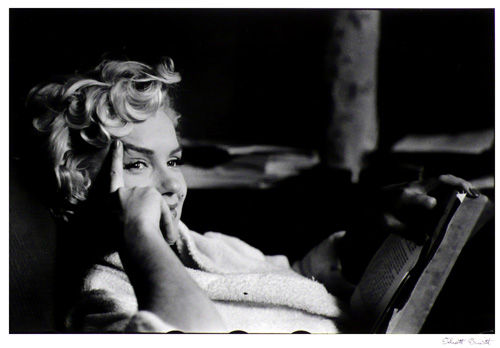
several images that have become icons of their kind. Most
are portraits, of either known or unknown subjects. All are
taken in the environment that is an extension of who they
are: James Dean hunched against the rain in Times Square,
even his cigarette moody in his mouth; Audrey Hepburn on set;
the backview of a girl dancing at the Venice Beach Rock Festival,
the crowds fanned out in front of her.
Born in New York in 1928, Stock’s father died when he
was still a young boy, and he left home to join the US Navy
aged sixteen. After leaving the Navy he became apprenticed
to LIFE Magazine photographer Gjon Mili, who had a reputation
for fine graphic sensitivity and a wild desire for experimentation
with light and movement. (Later Stock was to dedicate his
retrospective volume Made in the USA to Mili, Henri Cartier-Bresson,
W Eugene-Smith and Ernst Haas, four pure exponents of ‘humanist’
or ‘ concerned’ photography and rightly credited
with being a major influence – not only on Stock but
on a generation of photographers). From Mili, too, Stock seems
to have learnt the wisdom of attaching his passion for photography
to other passions in his life. From 1957-60 he focused on
the US jazz scene, producing some astonishing portraits: Louis
‘Satchmo’ Armstrong collapsed with laughter, surrounded
by friends and neatly hung suits in his dressing room; Miles
Davis among the drifting smoke and empty glasses at Birdland,
utterly absorbed by his music; Earl Hines with his band, flinging
himself backwards almost off his piano stool, all teeth and
keyboard.
For 20 years, Stock kept to the tradition of black-and-white
reportage, primarily for editorial outlets. He alternated
profiles of the charismatically famous with on-the-road projects
documenting bikers and Hell's Angels, or domestic series on
communal living and alternative lifestyles. Stock had joined
the Magnum agency (founded, with others, by at least two of
his photographc mentors) in the early 50s. By the end of the
60s he was ready to serve as the first vice-president of its
film division. In 1968 he had created a film production company,
Visual Obectives Inc., and was increasingly involved in mixing
media, using earlier work as stills. By the 70s he was moving
into Europe and into colours: by the 80s he could refer to
himself as a ‘colour essayist’. It was a period
of progression and change.
Yet, reflecting on the shift it accompanied – that is,
from urban to rural – he acknowledged that ‘moving
on has not been easy’. Moving to Provence in the south
of France, (the subject of his most lyrical large-scale anthology),
he finally returned to his parents’ home continent –
his father was Swiss, his mother British – and touched
on his father’s medium as a painter in that most painterly
of regions. He described his continuing practice of still
photography as belonging to the contemplative side of life,
essentially at odds with modern societies. (Yet in the last
couple of yars he has returned to the USA, living in Connecticut).
Conversely, Stock felt that ‘television, with its motion
and sound, gives the observer an initial thrill that can rarely
be matched by stills’. Indeed, in his 1994 essay ‘Dennis
Stock on Dennis Stock’, he expressed ‘high hopes
for the potential of the hand-held video camera as the Leica
of the future’. His desire to continue in both still
and moving media is now harnessed to his concern for environmental
protection that has persisted in his documentary journeys
from Japan to Alska, Hawaii, and back to his beloved France.
He has lectured widely on related themes, and run numerous
workshops across Europe and the United States. Yet it is hard
for the viewer not to continue to associate him with those
seminal portraits and photostories on both the glamorous and
the marginal in that most confused and confusing of cultures
that was the United States of the 50s through to the 70s:
a generation when every kind of change seemed possible, and
so many of which were realised.
SELECTED AWARDS
First Prize, LIFE Young Photographers, 1951
First Prize, International Photography, Polen/Poland, 1962
First Prize, Advertising Photographers of America, 1991
SELECTED
PERMANENT COLLECTIONS
Art Institute of Chicago, USA
International Center of Photography, New York
Creative Center for Photography, George Eastman House, Rochester,
USA
Musée d’Art Moderne, aris
National Gallery, Washington DC, USA
SELECTED
SOLO EXHIBITIONS
Schim Kunsthalle, Frankfurt, Germany, travelling exhibition,
1994
Mitsukoshi, Tokyo, thereafter touring major cities of Japan,
1994
Office Departemental de la Culture, Aix-en-Provence, France,
1990
Photofind Gallery, Woodstock, New York, 1985
‘Retrospective exhibition’, International Center
of Photography, New York, 1977
SELECTED
GROUP EXHIBITIONS
‘Magnum’, Worldwide, 2000
‘Magnum Cinema’, Worldwide Tour, 1995-1996
‘In Our Time, Magnum Photographers’, worldwide
travelling exhibition,1991
Arles Photography Festival, Arles, France, 1976
‘Photography at Mid-Century’, George Eastman House,
Rochester, USA, 1959
SELECTED
BIBLIOGRAPHY
Made in USA, Cantz, 1994
In Our Time, Magnum/Norton, 1990
Hawaii, Harry N Abrams Publishing, 1988
James Dean Revisted, Schirmer & Mosel, 1986; Chronicle
Books, 1987
Flower Show, Rizzoli/Magnus, 1986
Back
to top of page
All
prices are subject to change without notice and availability
is subject to prior sale. Please call or email the gallery
for current pricing & availability. Thank you!
©
2003 Hackelbury Fine Art, Ltd. Copyright for all images is
held by the respective artist or estate and they may not be
reproduced in any form without express premission. All rights
reserved. |